Professional Hair Relaxer Service: Process and Results
When it comes to permanently straightening textured hair, nothing delivers more consistent, long-lasting results than a professional hair relaxer service. As one of the foundational chemical services covered in our complete guide to professional hair chemical processing, relaxers represent decades of refinement in salon chemistry and technique. Whether you have coily 4C hair or loose 3A waves, understanding exactly how a professional relaxer service works, from the chemistry involved to the processing timeline to the finish you can realistically expect, puts you in control of one of the most significant decisions you can make for your hair. This guide walks you through relaxer types, the step-by-step salon process, safety considerations, and what your hair will look and feel like once the service is complete.
What Is a Professional Hair Relaxer Service?
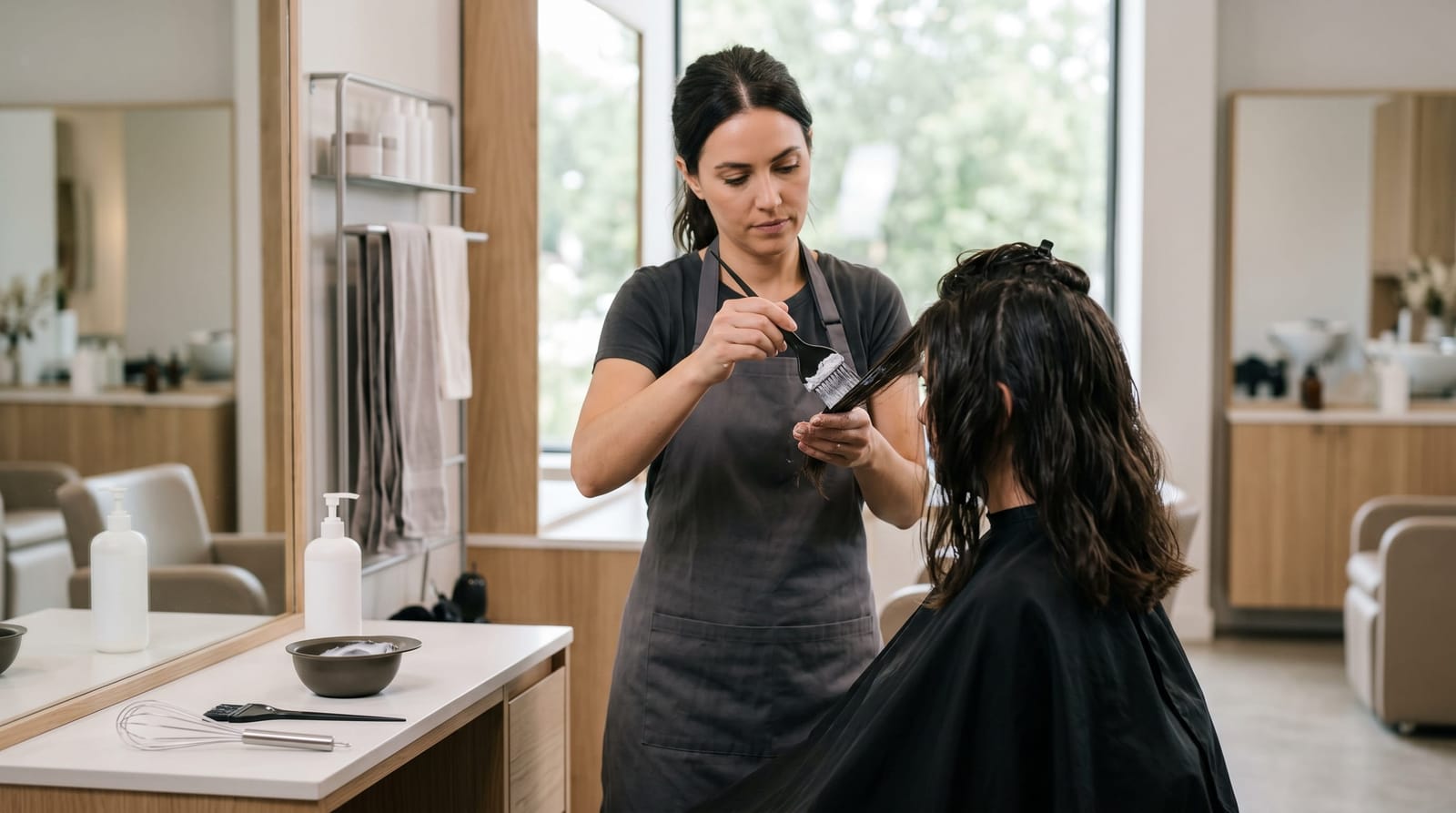
A professional hair relaxer service is a chemical treatment that permanently alters the protein bonds inside each hair strand to reduce or eliminate natural curl and wave patterns. Unlike heat styling, which temporarily straightens hair until the next wash, a relaxer chemically restructures the disulfide bonds in the hair's cortex, the bonds responsible for curl pattern, so that strands remain straight even when wet.
The key word here is professional. Over-the-counter relaxer kits are widely available, but professional hair relaxer services performed in a licensed salon differ in several critical ways:
- Strand testing: A licensed stylist performs a porosity and elasticity assessment before applying any chemicals, reducing the risk of breakage by identifying compromised hair in advance.
- Scalp protection: Professional-grade base creams and application techniques protect the scalp during processing.
- Precise timing: Stylists monitor processing time based on hair texture and target straightness: a window that can be as narrow as 5 minutes between under-processed and over-processed.
- Neutralizing shampoo: Proper neutralization stops the chemical reaction completely, which at-home kits frequently rush or skip.
According to the Professional Beauty Association, chemical services, including relaxers, account for approximately 30% of total salon revenue in the United States, underscoring just how common and in-demand these treatments remain. Clients seeking a professional hair relaxer service in the DMV area can expect a full appointment to run between 2.5 and 4 hours, depending on hair length, density, and whether a touch-up or virgin (first-time) application is being performed.
Types of Hair Relaxers Used in Professional Settings
Not all relaxers are created equal. Professional salons work with two primary chemical families, and the right choice depends on your hair's health, density, and how straight you want your final result to be.
Lye Relaxers (Sodium Hydroxide)
Lye relaxers use sodium hydroxide as the active straightening agent and operate at a pH between 12 and 14: among the highest pH values applied to human hair in any service. Because of their high alkalinity, lye relaxers work quickly, typically processing in 15 to 25 minutes, and deliver the straightest results. They are often the preferred choice for stylists working with coarse, resistant Type 4 hair textures. The trade-off is a higher potential for scalp irritation if the product contacts unprotected skin.
No-Lye Relaxers (Calcium or Potassium Hydroxide)
No-lye relaxers use guanidine hydroxide as their active ingredient: formed when calcium hydroxide and guanidine carbonate are mixed at the bowl. These formulas run at a slightly lower pH (around 9 to 11) and are gentler on the scalp, making them a popular option for clients with sensitive skin or children. However, no-lye systems can leave calcium deposits on the hair shaft over time, which may cause dryness if conditioning treatments are not incorporated regularly. They typically require processing times of 20 to 30 minutes.
Ammonium Thioglycolate (Thio) Relaxers
Used less frequently than hydroxide-based relaxers, thio relaxers are the same chemistry used in traditional perms, applied at a different pH and left straight rather than wrapped around rods. These are sometimes used on particularly fragile or previously color-treated hair because their mechanism is theoretically reversible, though practically speaking, the straightening achieved is still long-lasting. Processing times range from 15 to 20 minutes in most professional applications.
Choosing between these systems is something your stylist will determine after a thorough consultation, and it is one of the most important reasons to book a professional hair relaxer service rather than attempting the process at home.
The Professional Relaxer Application: Step-by-Step Timeline
Understanding exactly what happens during your salon appointment helps you arrive prepared and know what to expect at each stage. Here is a realistic breakdown of the complete professional relaxer service process.
Step 1: Consultation and Strand Test (15-20 Minutes)
Before any product is mixed, your stylist will evaluate your hair's current condition, porosity, elasticity, and natural texture. They will ask about previous chemical services, heat damage history, and your straightness goal, whether you want bone-straight results or prefer to retain some movement. A strand test on a small, inconspicuous section confirms how your hair responds to the chosen formula before full application begins.
Step 2: Scalp Preparation and Base Application (10-15 Minutes)
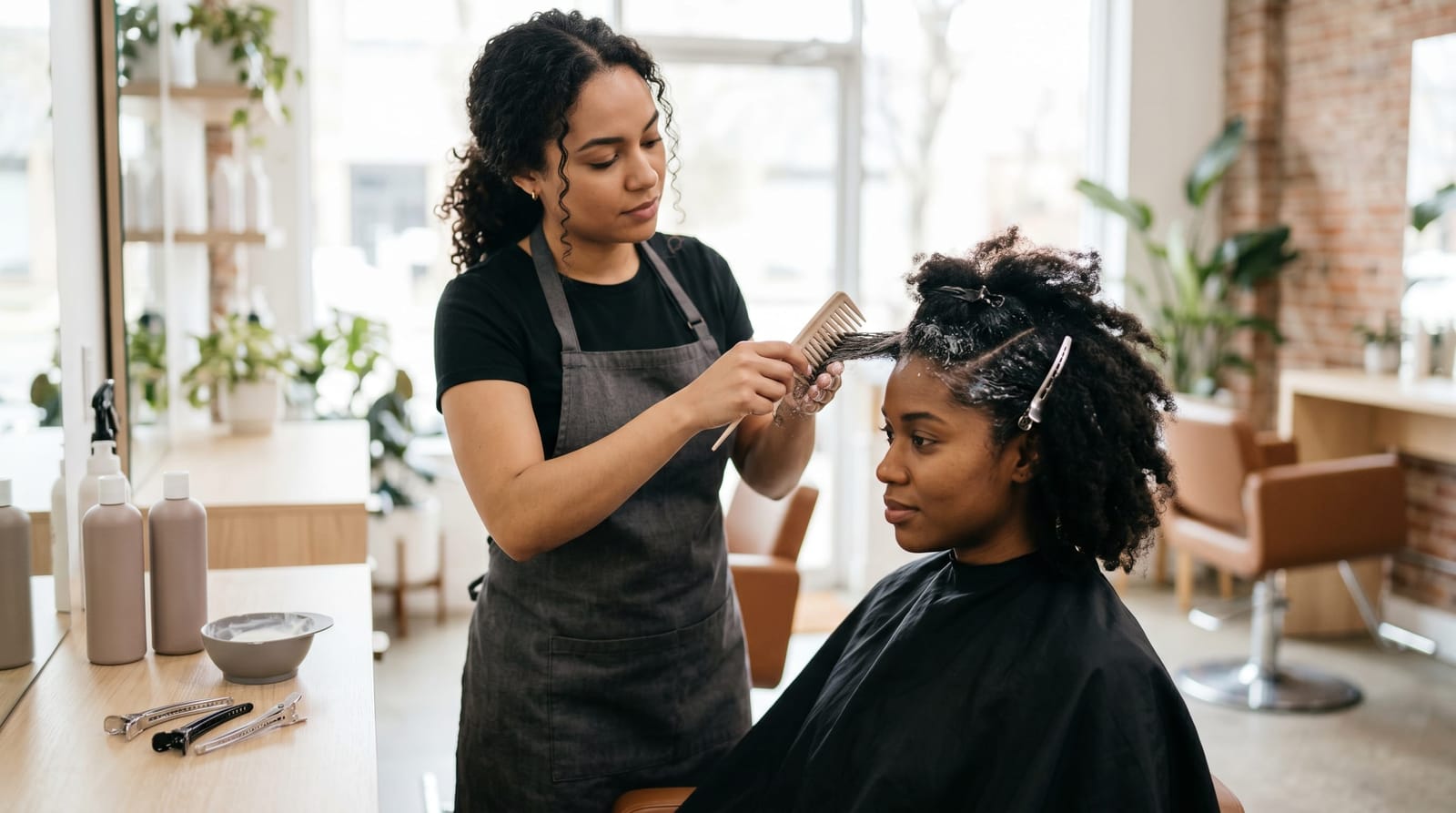
A petroleum-based or professional base cream is applied to the scalp, hairline, ears, and nape. This protective barrier is especially critical with lye relaxers and reduces the risk of chemical burns. Hair is sectioned into four quadrants to ensure even, methodical application.
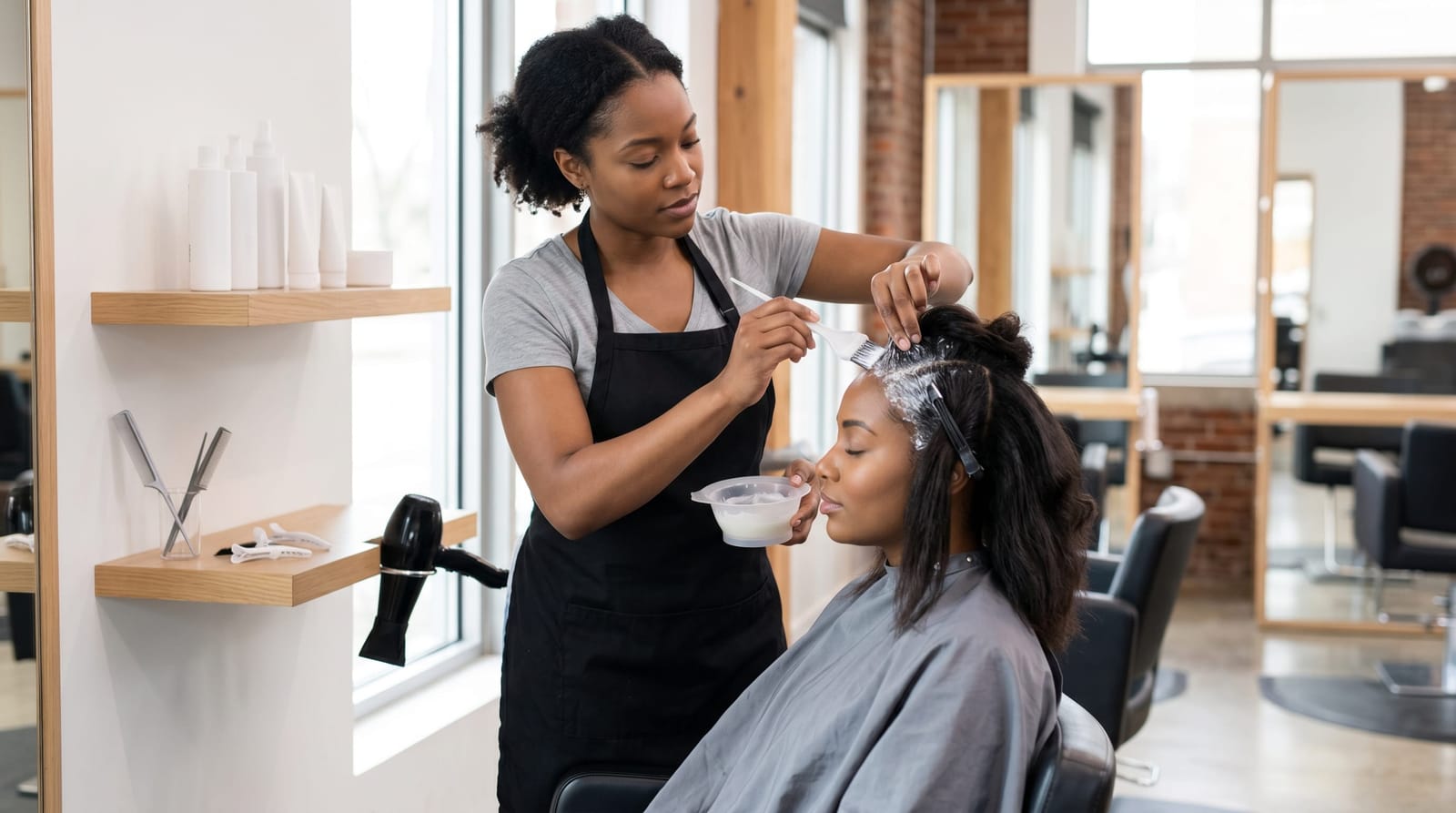
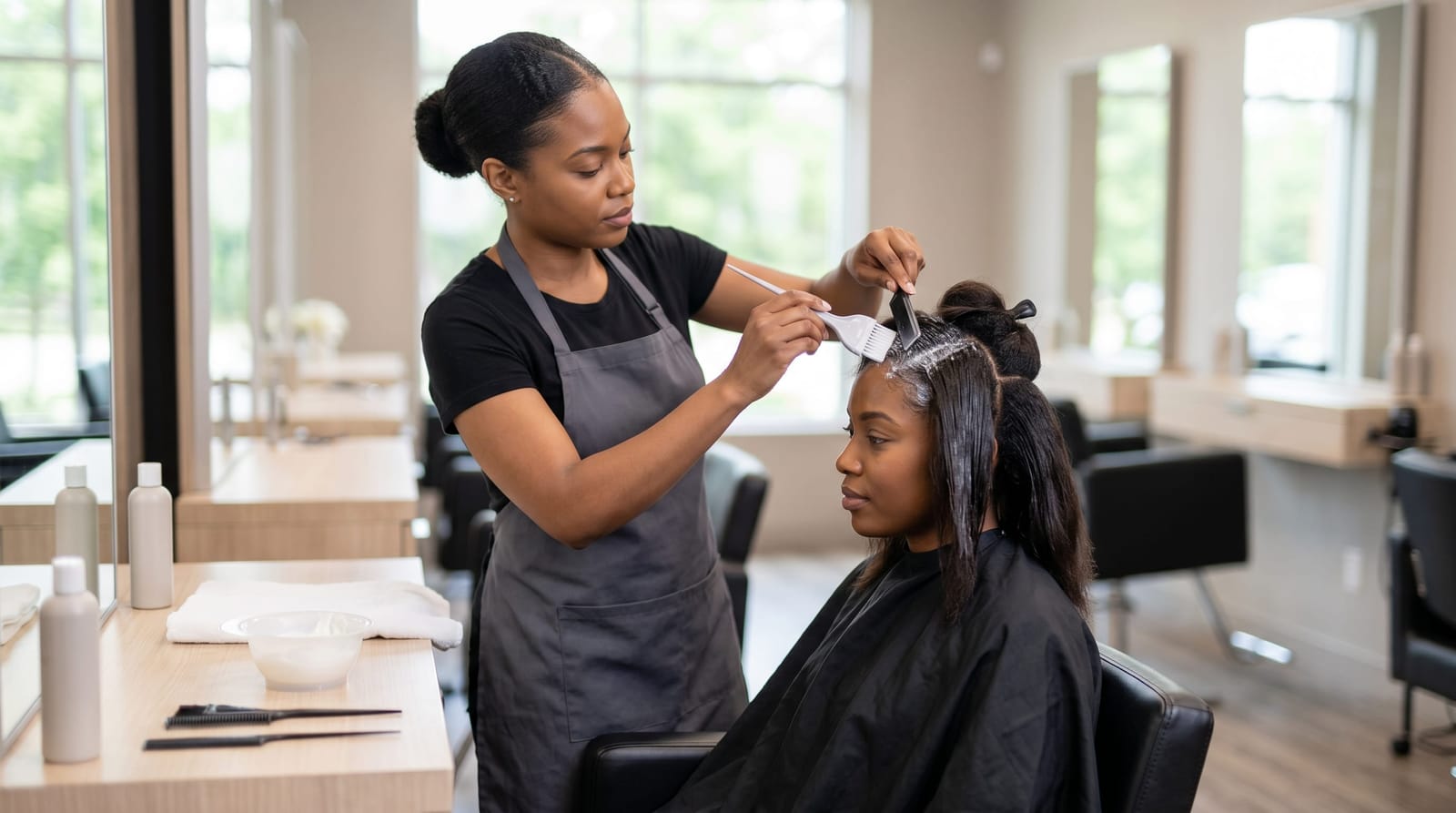
Step 3: Relaxer Application (10-20 Minutes)
Your stylist applies the relaxer product starting at the most resistant sections of your hair, typically the back and nape, working methodically through each quadrant. New growth is the target area for touch-up appointments; previously relaxed hair is typically not retreated unless absolutely necessary, as overlapping chemical application is one of the leading causes of breakage in relaxed hair.
Step 4: Processing Time (15-30 Minutes)
This is the most time-sensitive phase of the entire service. Your stylist will monitor the hair's response visually and by feel, typically smoothing the hair at intervals to check how the curl pattern is releasing. Most professional applications target a processing window that achieves 85-95% straightness: leaving a slight degree of resilience in the strand rather than processing to complete bone-straight, which stresses the hair's structural integrity.
Step 5: Rinsing and Neutralizing (15-20 Minutes)
The relaxer is thoroughly rinsed with warm water for a minimum of 5 minutes before neutralizing shampoo is applied. Neutralizing shampoo contains an acid-based formula (typically citric acid) that stops the chemical reaction and returns the hair's pH to its natural range of 4.5 to 5.5. Most professional protocols call for 3 to 4 passes of neutralizing shampoo, each left on the hair for 2 to 3 minutes. Many neutralizing shampoos include a color indicator that turns from pink to white when the pH has been fully normalized.
Step 6: Deep Conditioning and Finishing (20-30 Minutes)
Post-relaxer deep conditioning is non-negotiable in a quality professional service. The chemical process depletes moisture and temporarily weakens the hair shaft, and a professional-grade reconstructing treatment begins rebuilding internal protein bonds immediately after neutralization. Your stylist will then blow-dry and flat iron the hair to showcase the final result.
What Results Can You Realistically Expect?
One of the most common questions clients have before booking a professional hair relaxer service is: how straight will my hair actually be? The answer depends on several factors, including your natural curl pattern, hair density, the relaxer system used, and the processing time your stylist selects.
- Mild/Texturizer result: Curl pattern loosened by approximately 50-60%; hair retains wave and soft curl. (More on this approach in our post on texturizer treatment as a gentle curl loosening option.)
- Standard relaxer result: Curl pattern reduced by 75-90%; hair is smooth, manageable, and blow-dries straight with minimal effort.
- Bone-straight result: Curl pattern reduced by 95-100%; hair lies flat and has the least resilience in the strand structure.
Most professional stylists recommend targeting the standard result rather than bone-straight, because fully processed hair is more susceptible to breakage at the line of demarcation, the point where new growth meets relaxed hair, particularly as weeks pass between touch-up appointments.
Results from a professional hair relaxer service are permanent on the hair that has been treated. New growth returning at its natural texture is the primary reason clients return for touch-up services. On average, clients with moderate to fast growth schedules return every 8 to 12 weeks, though some stylists recommend extending this interval to 12 to 16 weeks to minimize scalp stress and overlapping. You can learn more about managing this timeline in our detailed breakdown of relaxer touch up schedule intervals and best practices.
Safety Considerations Every Client Should Know
A professional hair relaxer service is one of the safest ways to undergo chemical straightening, but only when performed correctly and on hair that is an appropriate candidate for the treatment. Here are the most important safety points to discuss with your stylist before your appointment.
Avoid Washing Before Your Appointment
Stylists recommend avoiding shampooing for 48 to 72 hours before a relaxer service. Washing removes the scalp's natural sebum layer, which provides a degree of protection against chemical irritation during processing. Do not scratch the scalp in the days leading up to your appointment either, as any micro-abrasions increase sensitivity.
Contraindications: When Not to Relax
Certain conditions make relaxer services inadvisable until the hair or scalp has been restored to health:
- Active scalp conditions including psoriasis, seborrheic dermatitis flare-ups, or open sores
- Hair that tests below a safe elasticity threshold (stretches and does not return, or breaks immediately when stretched wet)
- Hair that has been bleached or lifted to a level 7 or higher within the past 6 months
- Significant heat damage along the entire length of the hair
The Patch Test
Clients who are new to relaxers or who are switching relaxer brands should request a patch test 48 hours before their appointment. Apply a small amount of the mixed relaxer to the inside of the elbow or behind the ear and monitor for redness, itching, or swelling. Sodium hydroxide sensitization, while not common, does occur and can escalate with repeated exposure.
Clients interested in a less chemically intensive approach to texture modification may want to explore keratin treatment options for smoothing and frizz control, which work on the outside of the hair strand rather than altering its internal bond structure. Your stylist can help you determine which service aligns best with your hair goals and current condition.
Maintaining Relaxed Hair Between Salon Visits
The longevity and health of a professional hair relaxer service depend almost entirely on what happens between appointments. Relaxed hair requires a deliberately moisture-focused maintenance routine because the chemical process permanently reduces the hair's ability to retain water from its natural sebum distribution patterns.
Key maintenance practices include:
- Weekly deep conditioning: Alternate between moisturizing and protein-based treatments, applying a deep conditioner with heat for 20 to 30 minutes each session.
- Low-manipulation styling: Styles that do not require daily heat application significantly extend the life of the service and reduce breakage risk.
- Consistent moisture-sealing: The LOC (liquid-oil-cream) or LCO method applied to clean hair helps relaxed strands retain moisture between washes.
- Heat protectant use every time: Even though relaxed hair does not revert to its natural curl, high heat still degrades the protein bonds that keep hair structurally sound.
- Protective styling near the touch-up window: As new growth emerges, the line of demarcation becomes a vulnerability point. Low-tension protective styles during weeks 10 to 14 post-relaxer reduce breakage risk significantly.
A detailed regimen framework and product guidance are available in our post on chemical treatment aftercare and maintenance, which covers everything from weekly wash routines to how to handle the new growth phase safely.
Key Takeaways
A professional hair relaxer service is a highly effective, long-lasting solution for clients seeking to reduce or eliminate their natural curl pattern, but the results you experience are directly tied to the expertise of your stylist, the condition of your hair at time of service, and the quality of your post-treatment care. Understanding the chemistry, the process timeline, and realistic outcome expectations empowers you to make informed decisions and communicate clearly with your stylist. Whether you are considering your first relaxer or refining a routine you have followed for years, the right professional partnership makes all the difference.
Ready to experience a safe, expertly performed professional hair relaxer service? Contact our salon to schedule a consultation and let our licensed stylists assess your hair and recommend the ideal approach for your texture and goals.