How to Maintain Your Haircut Style Between Salon Visits
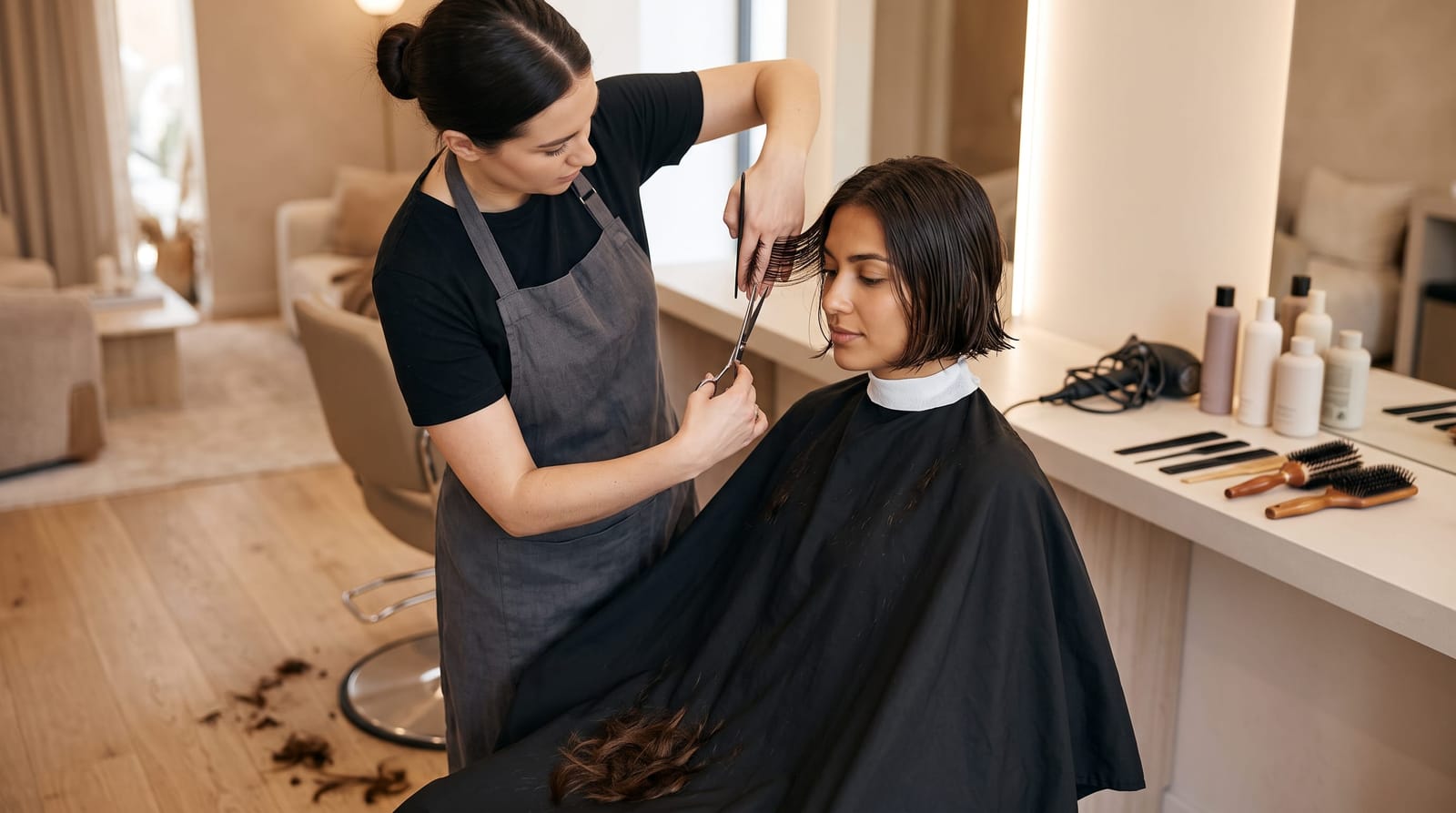
To maintain your haircut at home, focus on preserving its shape rather than recreating your entire salon finish every morning. Gentle detangling, moisture suited to your current style, a comfortable satin bonnet or scarf, and small, targeted touch-ups can keep your outline and layers looking intentional.
For thick, curly, and coily hair, the key distinction is how you are wearing your cut: in its natural texture, stretched, or blown out. Each finish needs a different routine. The steps below help you care for your ends, keep edges neat without overworking them, and recognize when scissors are not the answer.
1. Separate Your Haircut Shape From Your Salon Finish
A haircut and a blowout do different jobs. We offer both at Kabelly Dominican Salon in Clinton: the cut establishes your outline and layers, while the blowout creates a temporary smooth finish. A change in the finish does not necessarily mean your haircut has lost its shape.
Before building your home routine, identify the features you want to preserve:
- A rounded curly shape: Notice the balance between the crown, sides, and ends.
- A bob or defined perimeter: Pay attention to where the bottom edge falls and how the ends sit.
- Face-framing layers: Note your usual part and the direction the front pieces fall.
- A short tapered cut: Notice the contrast between the fuller top and closer sides.
Take front, side, and back photos of your finished style. They provide a useful reference for your part, volume, and silhouette. Compare your hair in the same state: a fresh blowout and air-dried curls will not have the same visible length or fullness.
2. Make Wash Day Support the Shape
Trying to preserve a style indefinitely can leave you layering fresh product over old product. When the roots feel coated, curls stop responding to a light refresh, or the finish feels heavy, a proper wash may be more useful than another styling touch-up.
Choose your washing rhythm around your activity, product use, and how your hair feels, rather than a fixed calendar that ignores those differences.
- Cleanse the scalp and roots. Work gently rather than piling the lengths together and scrubbing them into tangles.
- Condition the lengths. Distribute conditioner through manageable sections, paying attention to the ends.
- Detangle with slip. While conditioner makes the hair easier to separate, work from the ends upward with fingers or a suitable wide-tooth comb.
- Blot instead of rubbing. Use a soft towel or T-shirt to remove excess water without roughing up the finish.
Thick hair benefits from sections because they make it easier to reach interior strands. They also help you avoid leaving the outer layer saturated with product while the underneath receives very little.
3. Match Your Moisture Routine to Your Current Style
The right product used at the wrong moment can work against your styling goal. A water-based curl refresher may help reshape natural curls, but it can also encourage blown-out hair to return toward its natural texture.
For natural curls and coils
After washing, spread a leave-in conditioner through damp sections if your hair needs it. Follow with a styling cream, mousse, or gel according to the definition and hold you prefer. More products do not automatically create a better result.
Between washes, begin with the area that actually needs attention. Lightly dampen a flattened section, smooth it with your fingers, and reshape the curl. Add a little styling product only if water alone does not give the finish you want.
If your layers look limp or coated, pause before adding another cream. Product buildup can obscure the shape you are trying to show.
For a blowout or stretched finish
Let wash-day conditioning do most of the moisture work. Between washes, a small amount of lightweight finishing serum on the ends can add slip and polish without wetting the whole style. Oil and serum are finishing options, not substitutes for conditioning.
If your priority is maintaining a smooth finish, use a shower cap during showers and keep wet styling products away from the lengths. If your hair needs a full wash and conditioning session, let that take priority over extending the blowout.
4. Protect the Shape Before Bed
A satin bonnet or scarf gives your hair a smoother surface to rest against and helps keep the style contained overnight. The fit matters as much as the fabric: the covering needs to stay in place without squeezing your hairline or crushing your shape.
- Long curls: A loose, high gathering may keep you from sleeping directly on the ends. Use a soft tie without pulling the roots tight.
- Short curls or a tapered cut: A roomy bonnet may work better than forcing the hair into a ponytail.
- A straight bob or layered blowout: A gentle wrap can preserve a smooth outline if it suits your length and you know the technique.
- A blowout with body or curled ends: Loose pin curls may preserve the bend better than wrapping everything flat.
A satin pillowcase is a useful backup if your covering slips off. Let freshly styled hair dry completely before covering it for bed so it does not set into a flattened or unintended shape overnight.
5. Refresh Only What Has Changed in the Morning
Remove your bonnet or scarf and let your hair settle before deciding it needs restyling. Then check the part, crown, front pieces, and ends. Often, just one area needs attention.
For curls, lift gently at the roots with your fingers without pulling through every curl. Lightly dampen and reshape individual sections that have flattened. Daily dry brushing is not necessary for a defined curly style and can separate the curl groups that give it shape.
For a blowout, start with a gentle comb-through or finger adjustment. If heat is part of your touch-up, use heat protectant as directed, work on fully dry hair, and focus on the section that needs reshaping rather than repeatedly passing over the whole head.
For example, a bob with one flipped-out side may need only that section redirected. A curly cut with a flat crown may need a little root lift, not more product through the ends.
Short styles require their own approach to direction and volume. Our guide to styling a short haircut at home for natural and relaxed hair covers those more closely cropped shapes.
6. Keep Edge Care Gentle and Optional
A neat hairline can complement a haircut, but perfectly laid edges are not required for a polished style. The goal is a finish you enjoy without repeatedly brushing, pulling, and recoating the same small area.
If you use edge control, begin with a light application and guide the hair with your fingertips or a soft brush. Choose a direction the hair follows comfortably rather than pulling it into a dramatically different pattern.
Avoid adding fresh layers whenever yesterday’s product starts to look dull or flaky. Gently cleanse away buildup as part of your routine instead. Keep tight ponytails and snug scarf knots from doing the work of holding edges flat. Your nighttime covering can rest securely without being pulled tight across the hairline.
7. Know When Not to Self-Trim
A strand that appears longer than the rest is not automatically out of place. Curl patterns can vary across the head, and one section may be more stretched, less defined, or carrying a different amount of product.
Put the scissors aside when:
- Your hair has just come out of a bun, wrap, or ponytail. Temporary bends can make the outline look uneven.
- You are comparing wet curls with dry curls. Their visible lengths differ, so an improvised correction can remove more than intended.
- You want to fix layers at the back. Limited visibility makes balance difficult to judge.
- You are tempted to shorten every frizzy or undefined piece. Those pieces may need cleansing, conditioning, or restyling rather than cutting.
- You are reshaping bangs, a taper, or face-framing pieces. Small changes can noticeably alter the design.
Reset the section first and assess it when fully dry in your usual style. Keep household scissors out of the routine. A trim removes length, and guessing at the outline can change more of the haircut than you intended.
8. Recognize When Maintenance Has Become Reshaping
There is no single trim schedule that suits every textured haircut. A sharply defined bob or short taper usually shows growth more noticeably than a longer, softer layered shape. The useful question is whether your usual routine still produces the silhouette you want.
Signs that the cut itself may need attention include:
- The perimeter stays uneven after washing and styling normally.
- Face-framing pieces repeatedly fall into a different position.
- Layers no longer distribute volume where you want it.
- The ends remain difficult to detangle after conditioning.
- You keep adding styling steps to compensate for a changing outline.
Save a photo and note what has become harder to manage. “The sides feel fuller than I want” or “the front pieces no longer sit above my shoulders” communicates more clearly than “it needs fixing.” That distinction helps separate a small trim from a change in shape.
Keep Your Routine Focused
Maintaining a haircut is not about making every strand behave identically each day. Preserve the overall shape, care for the ends, and adjust your routine to the texture you are wearing. A thoughtful wash day, gentle nighttime protection, and selective morning touch-ups do more for a consistent finish than constant restyling or an impulsive trim.