Dominican Blow Out vs Regular Blow Out: What's the Difference
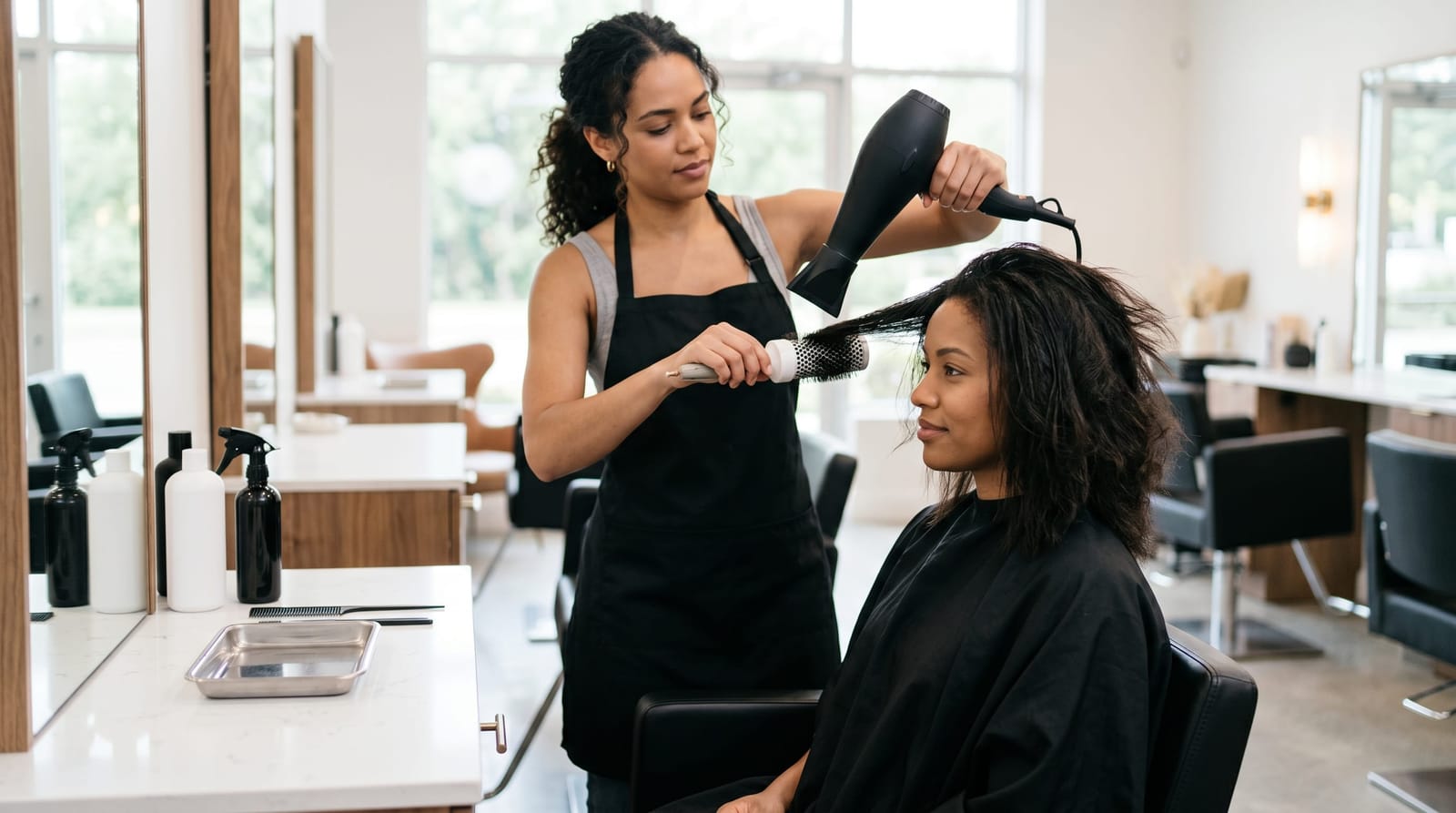
When it comes to achieving smooth, straight, frizz-free hair, not all blow outs are created equal. If you've been exploring professional styling options, you've likely come across the term Dominican blow out technique, and wondered how it stacks up against the standard blow out you might get at any neighborhood salon. The difference is significant, and for women with textured, curly, or natural hair especially, choosing the right method can mean the difference between hair that looks polished for two weeks versus two days. As part of our Ultimate Guide to Professional Blow Outs at a Dominican Salon, this post breaks down exactly what sets the Dominican blow out technique apart, from the conditioning philosophy and tools to the multi-step process and lasting results.
The Core Philosophy: Conditioning First, Heat Second
The most fundamental difference between a Dominican blow out and a regular blow out starts before the heat even touches your hair. The Dominican blow out technique is rooted in a conditioning-first philosophy that was developed in Dominican salons, where stylists served clients with dense, highly textured curl patterns on a daily basis. The goal was never just straightening: it was strengthening and nourishing the hair so it could withstand repeated styling without deteriorating over time.
A standard blow out at most salons typically involves shampooing, applying a light leave-in or heat protectant, and immediately blow drying. The entire service might take 30 to 45 minutes. The Dominican blow out technique, by contrast, begins with a deep conditioning treatment that typically sits on the hair under a hooded dryer for 15 to 30 minutes. Studies on heat and hair damage consistently show that adequately moisturized hair sustains significantly less breakage during thermal styling than dry or under-conditioned hair: some hair care researchers estimate up to 40% less breakage when hair is properly hydrated before heat application.
This conditioning step is not optional or abbreviated. It is the foundation of the entire service. The deep conditioner used in a Dominican blow out is typically richer and more protein-heavy than standard conditioners, designed to temporarily reinforce the hair shaft before heat is applied. This is why clients consistently report that their hair feels healthier and softer after a Dominican blow out technique, not just straighter.
The Multi-Step Process vs. the Single-Step Standard
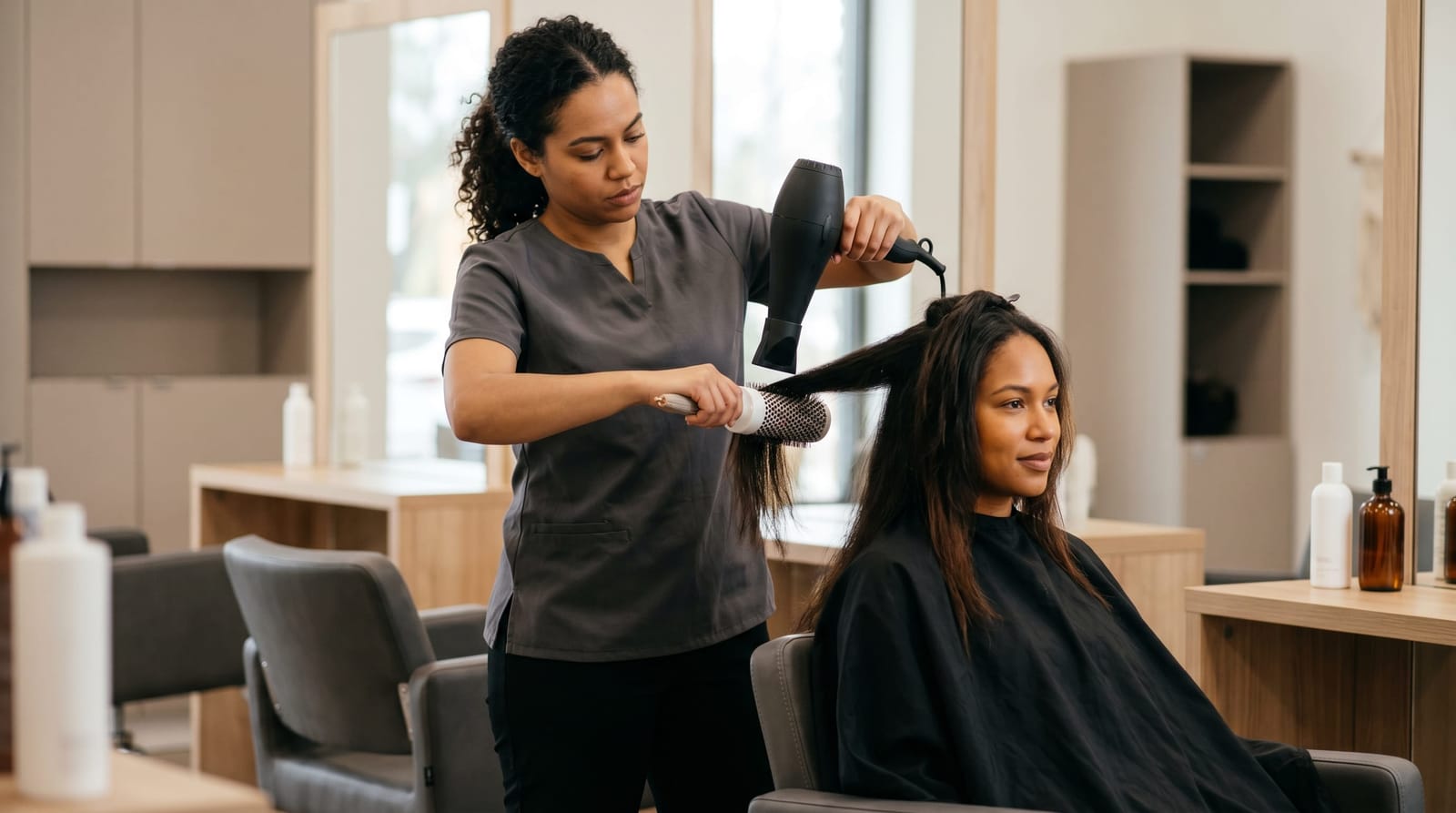
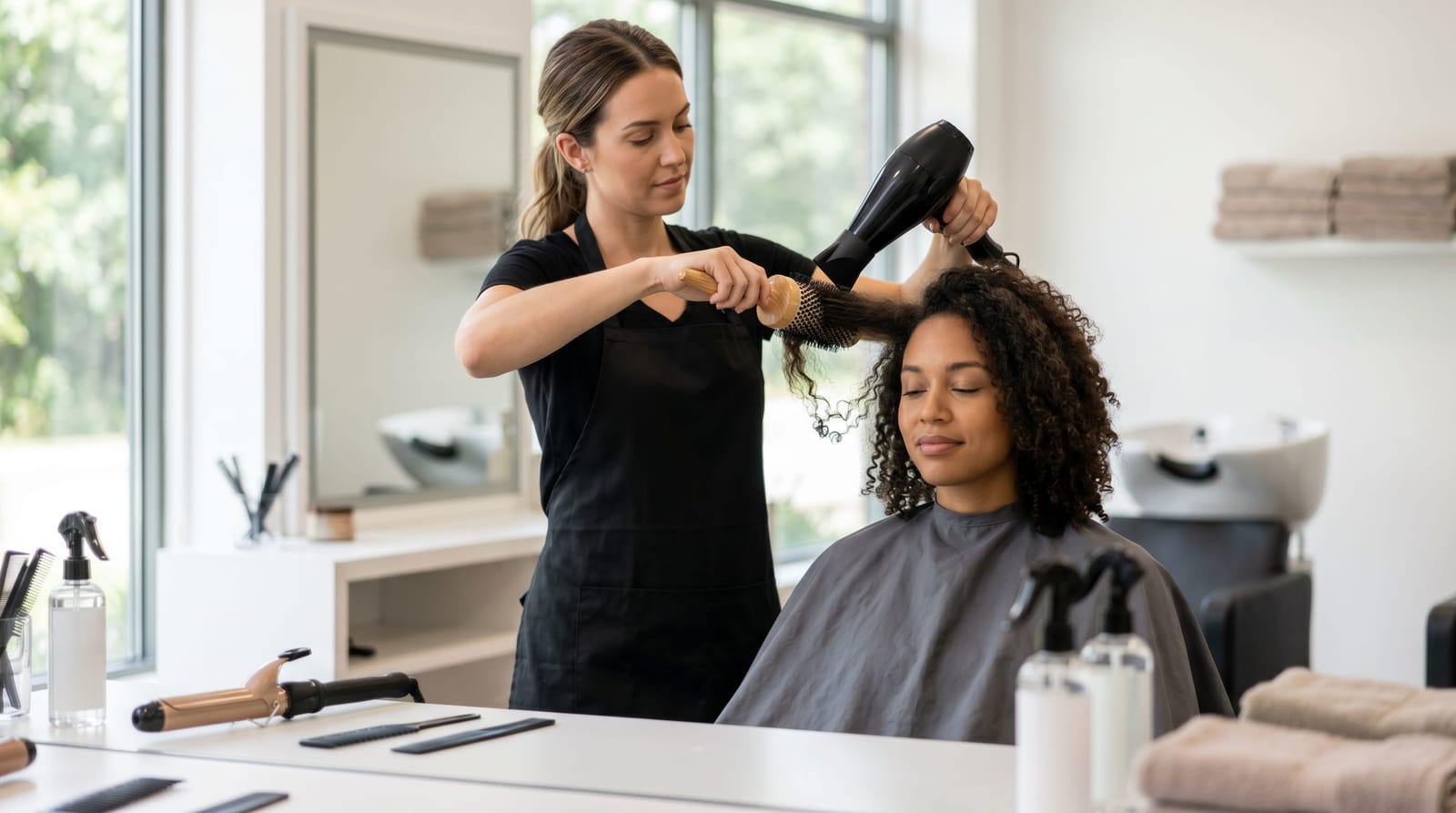
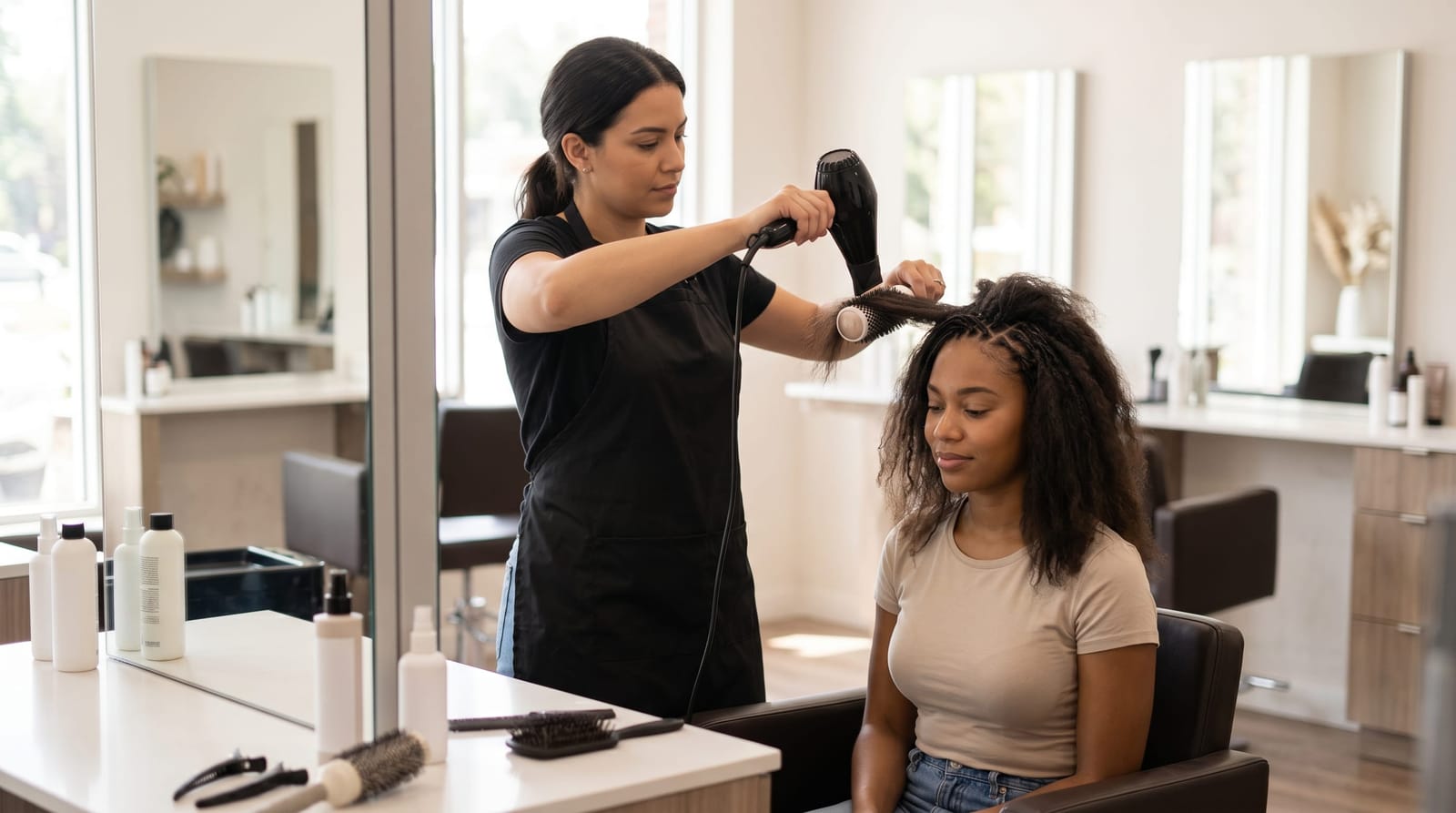
A regular blow out is essentially one step: blow dry the hair straight using a round brush or paddle brush, section by section, until dry and smooth. It is effective for fine to medium hair textures, but for naturally curly or coily hair types, particularly Type 3C through Type 4C, a single pass with a blow dryer rarely achieves a fully smooth result without excessive heat and multiple passes that risk heat damage.
The Dominican blow out technique is a true multi-step process, and each step serves a specific purpose:
Step 1: Wash and Deep Condition
The hair is shampooed, then generously coated with a deep conditioner and placed under a hooded dryer for 15 to 30 minutes. This step is non-negotiable in the Dominican blow out technique and accounts for much of the method's superior results on textured hair.
Step 2: Roller Set Under the Hood Dryer
After rinsing the conditioner, the hair is set on large magnetic rollers and placed back under the hooded dryer until approximately 80 to 90% dry. This roller setting step is one of the most distinctive elements of the Dominican blow out technique. By partially drying the hair in a stretched, wrapped-around-roller formation, the stylist is working with tension and low heat rather than high heat alone. This dramatically reduces the temperature needed during the blow dry stage that follows, which is exactly why the Dominican blow out technique causes less heat damage than methods that rely entirely on blow dryer heat from wet hair.
Step 3: Blow Dry with a Denman or Round Brush
Once the rollers are removed, the hair is blow dried section by section. Because the hair is already 80 to 90% dry from the roller set, the stylist needs far fewer passes with the blow dryer to achieve a straight result. This stage smooths the hair and adds directional tension to eliminate remaining curl.
Step 4: Wrap and Hood Dry
The hair is then wrapped around the head in a flat, circular pattern, a technique called the "Dominican wrap", and covered with a satin or nylon cap before going back under the hooded dryer for a final 10 to 15 minutes. This finishing step seals the style, adds a mirror-like shine, and ensures the straightening effect is locked in. Most standard blow outs skip this step entirely.
The Tools That Make the Dominican Blow Out Technique Unique
Professional tools are another major differentiator between the Dominican blow out technique and a regular blow out. Where a standard blow out service might require nothing more than a blow dryer and a round brush, a proper Dominican blow out uses a curated set of specialized tools, each selected for a specific function.
The Hooded Dryer
The hooded dryer is the cornerstone tool of the Dominican blow out technique. Unlike a handheld blow dryer that concentrates high heat on small sections, the hooded dryer distributes even, lower heat across the entire head simultaneously. This even heat distribution is crucial during both the roller set stage and the final wrap stage. According to professional stylists trained in the Dominican blow out technique, the hooded dryer allows the hair to dry at temperatures typically 20 to 30 degrees lower than what would be needed with a handheld blow dryer alone: a meaningful difference for hair health over time.
Magnetic Rollers
Large magnetic rollers, typically 2 to 3 inches in diameter, are used in the roller set stage. The size of the roller matters: larger rollers create stretch and volume without creating tight curl or wave, which would need to be removed with additional heat. Most regular blow out services use no rollers at all.
The Denman Brush
During the blow dry stage, a Denman brush or a wide-toothed paddle brush is used to guide the hair smooth. The tension created by the brush working in concert with the blow dryer is what achieves the characteristic smooth, non-frizzy finish of the Dominican blow out technique.
Results: How Long Each Method Lasts and What It Delivers
For many clients, the duration and quality of results is the most compelling reason to choose the Dominican blow out technique over a standard blow out.
A regular blow out, even a well-executed one, typically lasts 3 to 5 days for clients with straight or wavy hair, and often only 1 to 2 days for clients with tightly coiled or natural hair, especially in humid climates. The results revert quickly because the straightening relies entirely on temporary tension created during blow drying, with no additional setting or sealing steps.
The Dominican blow out technique, by contrast, consistently lasts 1 to 2 full weeks for most hair types. For clients with Type 3 curl patterns, results can last up to 2 weeks with proper maintenance. For clients with Type 4 natural hair, results typically last 7 to 10 days, depending on humidity exposure and nighttime care. This extended longevity is a direct result of the roller set and wrap steps: both of which set the straight pattern more deeply than a single-stage blow dry can achieve.
Beyond longevity, the finish quality also differs. A standard blow out often leaves hair with volume and body but some residual frizz at the surface. The Dominican blow out technique produces a notably smoother, shinier result, what clients often describe as a "silky" finish, because the wrap and final hooded dryer stage polishes the cuticle flat before the style is complete.
If you're specifically considering this service for natural or coily hair, the detailed breakdown in our guide to Dominican blow out natural hair covers what to expect during your first appointment, including how your specific curl pattern affects the process and results.
Dominican Blow Out Technique vs. Silk Press: A Quick Distinction
Clients comparing options often ask how the Dominican blow out technique differs from a silk press, since both are popular for natural hair. The silk press, which emerged around 2010, is actually a hybrid of the Dominican blow out technique and the traditional hot comb press. It uses flat irons as the primary tool after the blow dry stage, creating an extremely pin-straight result. The Dominican blow out technique, by contrast, does not typically involve flat iron passes: the straightening is achieved through the roller set, blow dry, and wrap method alone.
This distinction matters because flat irons operate at significantly higher temperatures than the tools used in the Dominican blow out technique. A flat iron set at 400°F on a single pass delivers more concentrated heat to the hair shaft than the combination of hooded dryer and blow dryer used across the multi-step Dominican blow out process. For clients prioritizing minimal heat damage alongside a straight result, the Dominican blow out technique is generally considered the lower-heat option of the two.
If you're curious about the full experience of a professional Dominican-style service, from shampoo through final styling, our guide to the wash and blow out near me experience walks through every stage of what a complete appointment looks like.
Is the Dominican Blow Out Technique Right for Your Hair?
The Dominican blow out technique was developed specifically to serve clients with textured, natural, and highly coiled hair: making it an excellent fit for hair types that standard blow outs frequently underserve. However, it works well across a range of textures. Here's a quick breakdown of who benefits most:
- Type 3C to 4C natural hair: The primary audience for the Dominican blow out technique. The multi-step, conditioning-heavy process addresses the specific needs of these textures better than single-step methods.
- Color-treated or chemically processed hair: Because the Dominican blow out technique emphasizes conditioning and lower heat levels, it is often a safer choice for hair that is already compromised from chemical services.
- Fine to medium textured hair: The technique works but may be more than necessary for hair types that respond well to simpler methods.
- Anyone seeking 1-2 week longevity: If you want your straight style to last through the week and beyond, the Dominican blow out technique significantly outperforms a standard blow out in staying power.
It is also worth noting that the Dominican blow out technique is considerably more difficult to replicate at home than a standard blow out. The hooded dryer, large magnetic rollers, and wrapping technique require professional equipment and trained hands. This is a service where the salon environment genuinely matters: the tools and expertise together are what produce results that home styling cannot easily match.
For clients who want a smooth style but are working with braided or protective styles, the technique adapts as well. Our overview of blow out for braids covers how the conditioning and heat principles of Dominican styling apply specifically to braid prep and finishing.
Related Topics Worth Exploring
The Dominican blow out technique is a broad subject with several important subtopics for clients who want to go deeper. If you are considering your first appointment and have natural hair, the guide to Dominican blow out natural hair covers what your specific curl type means for timing, product selection, and final results. For clients who have already experienced the service and want to protect their investment, a dedicated post on blow out maintenance and longevity tips covers the nighttime routines, humidity management, and refresh methods that keep the style looking fresh through the full two weeks.
Conclusion
The Dominican blow out technique is not simply a faster or fancier version of a standard blow out: it is a fundamentally different approach to thermal straightening, built around conditioning, multi-step processing, and specialized tools that deliver results lasting 1 to 2 weeks with minimal heat damage. For clients with textured or natural hair especially, the difference in both quality and longevity is significant. If you've been settling for a regular blow out that reverts by day two, the Dominican blow out technique offers a meaningful upgrade. Ready to experience the difference firsthand? Book your appointment at our Dominican blow out salon and see what a true professional blow out can do for your hair.